PRACTICAL PLANNING GUIDE
How to calculate shelf length for dado joints
By GrainBench · Updated October 22, 2026
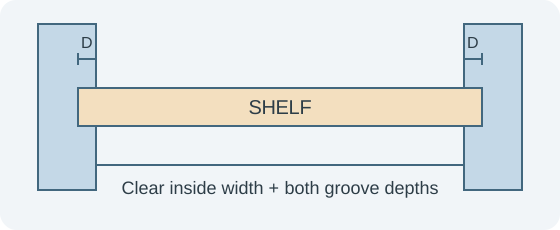
For equal-depth grooves in both sides, shelf length = outside case width − two side thicknesses + two groove depths. Add the amount entering each groove to the clear inside width.
Jump to a section
Work from the actual side thickness
Record the outside case width, measured side thickness and chosen groove depth. Do not subtract a nominal 3/4 inch if the delivered sheet measures something else. If the two sides or grooves differ, subtract each side thickness and add each groove depth separately.
Example in inches
Use a 30-inch outside width, two actual 3/4-inch sides and a 1/4-inch groove in each side. Inside width is 30 − 1 1/2 = 28 1/2 inches. Add 1/2 inch for the two groove engagements: the shelf is 29 inches long.
The case top and bottom may still fit between the sides at 28 1/2 inches. Extending the internal shelves into grooves does not automatically change the top and bottom joints. Label these parts separately so a longer shelf is not mistaken for a case panel.
Metric example
For a 760 mm outside width, actual 18 mm sides and 6 mm grooves: 760 − 36 + 12 = 736 mm. The inside width is 724 mm. Both 6 mm shelf engagements are included in the 736 mm finished length.
Groove width and depth are separate settings
Width is the vertical opening that receives the shelf thickness. Depth is how far the cut enters the side face. A nominal router-bit diameter does not prove a snug fit in the finished cut. Use a shelf offcut to test the actual groove, with flat bottoms and square shoulders.
The length formula reaches the two groove bottoms; it is a target geometry, not an allowance for inaccurate cutting. Dry-fit both sides and shelves at the intended outside width. Do not force an overlong shelf between the sides or rely on adhesive to fill a loose joint.
Mark the lower groove edge from one datum
Give each groove’s lower and upper edges from the bottom of the side panel. The lower edge supports the shelf underside. These are finished part coordinates, not router fence offsets. Mirror the sides using each panel’s own bottom, front and inside face references.
Calculate equal shelf positions before transferring marks. For a complete case, Plan Studio provides a groove schedule, cut list, joint section and assembly sequence. Its through grooves remain open at the front and rear; it does not infer stopped dados or a load capacity.
Sources and scope
Reviewed October 22, 2026. Original GrainBench explanations and calculated examples. Hardware references describe the named products; drawings are schematic. No independent load testing is claimed.