Free calculator
Cut-List Optimizer
Type your finished parts and the sheets you’ll buy. The cutting plan updates as you go, with grain, saw kerf and offcuts included.
Start from a free plan
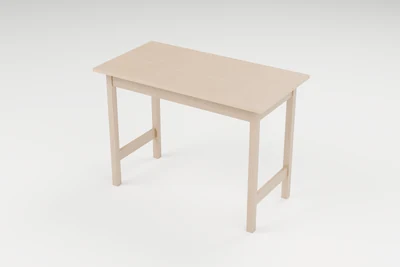
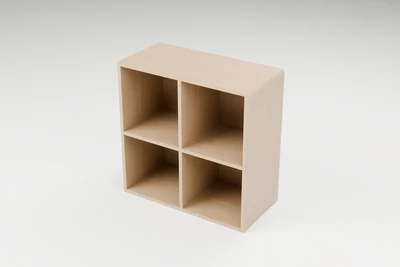
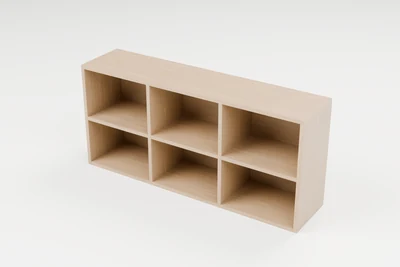
Loads the plan’s parts into the optimizer. Solid boards get their own stock row, so set it to the board you have. View the plans: Weekday Writing Desk · Weekend Record Cabinet · Low Line Media Cabinet.
New to sheet goods?
A little guidance before you buy plywood.
A sheet calculator can tell you the area. It cannot tell you whether the parts fit after the blade has had its share. Read the grain, measure the panel you were actually sold, and plan the first rip before you carry a 4×8 sheet through the shop.
Grain direction on a sheet
On most hardwood plywood the face veneer runs the long way of a 4×8 sheet. Parts that people will see, such as a bookcase side, usually want that face grain running with their length. The optimizer keeps that lock. A back, a drawer bottom, or a shop jig can be marked “either” so it may turn.
MDF has no solid-wood grain, but a labelled direction still keeps a face consistent if you care about the sanded surface. If you truly do not care, set the sheet to ignore grain. Measure the panel before you trust a nominal 3/4 inch. A 23/32 inch sheet is a different thickness, and it should not be mixed into a 3/4 inch layout unless you measured them within 0.5 mm.
How to read a cut list · Plywood · MDF · My Build Brief · Plan Studio
Questions about cutting sheet goods
What does the cut-list optimizer do?
It lays the finished parts you enter onto sheet goods. Parts of the same material and thickness share a sheet. The drawing is a strip layout: rip a strip, then crosscut the parts out of it, with the saw kerf left as a gap.
How does saw kerf change the layout?
Kerf is the width the blade turns into sawdust. The default is 1/8 inch. A wider blade leaves less room in each strip and along each sheet, so the same parts can need another sheet. Edge trim, if you set one, is kept clear on every side before the first cut.
Why does grain direction matter?
Plywood and MDF have a face direction even when the core is not solid wood. Lock a part’s length to the grain and it will not be turned to save a sheet. Choose “either” only when the face direction does not matter for that part.
Why don’t different thicknesses share a sheet?
A 3/4 inch side and a 1/4 inch back are different boards. Panels within 0.5 mm of thickness are treated as the same stock so a measured 19 mm panel can sit with a nominal 3/4 inch part. Anything further apart gets its own sheets.
What does yield mean?
Yield is the area of the placed parts divided by the area of the sheets opened for them, rounded to the nearest percent. Offcuts you keep are still part of the sheet you bought. It is not a promise of the minimum you can buy.
Is this a shop-tested layout or a strength check?
No. It is a planning aid that runs in your browser. It does not know defects, blade wander, or how a panel is supported, and it says nothing about whether a shelf will sag. The PDF is a scaled reference. Cut to the dimensions, not to the picture.
The layout stays in this browser. Nothing is uploaded, and there is no account. Clearing the site’s data removes the saved cut list, so copy it or download the PDF if you want to keep it.